Classic Fiat 500 (1936–1975): History, Engineering & Driving Experience
Dec 16, 2025 • 14 minutos de tiempo de lectura
Classic Fiat 500 (1936–1975) – History, Engineering & Driving Experience
The Rich History of the Classic Fiat 500
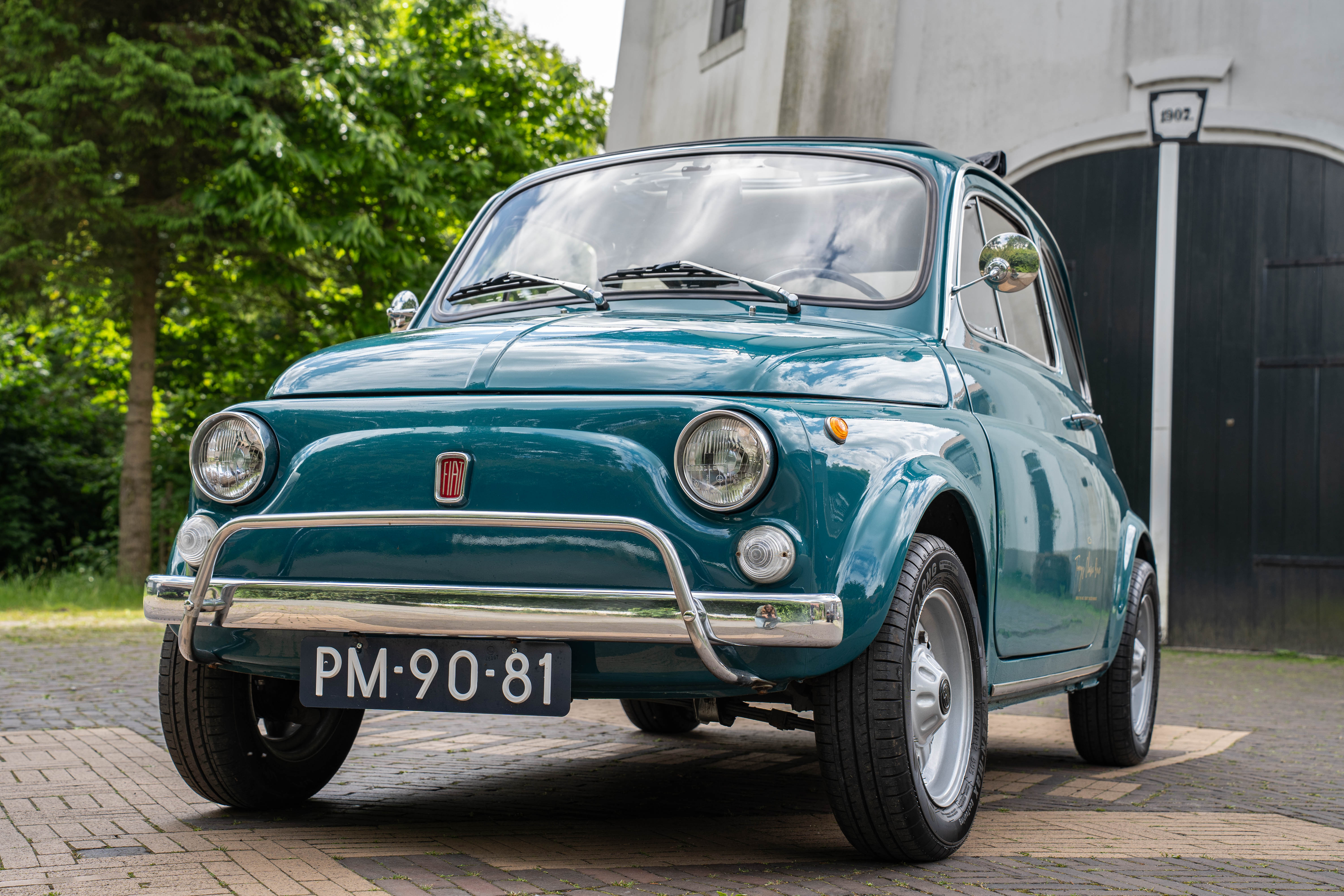
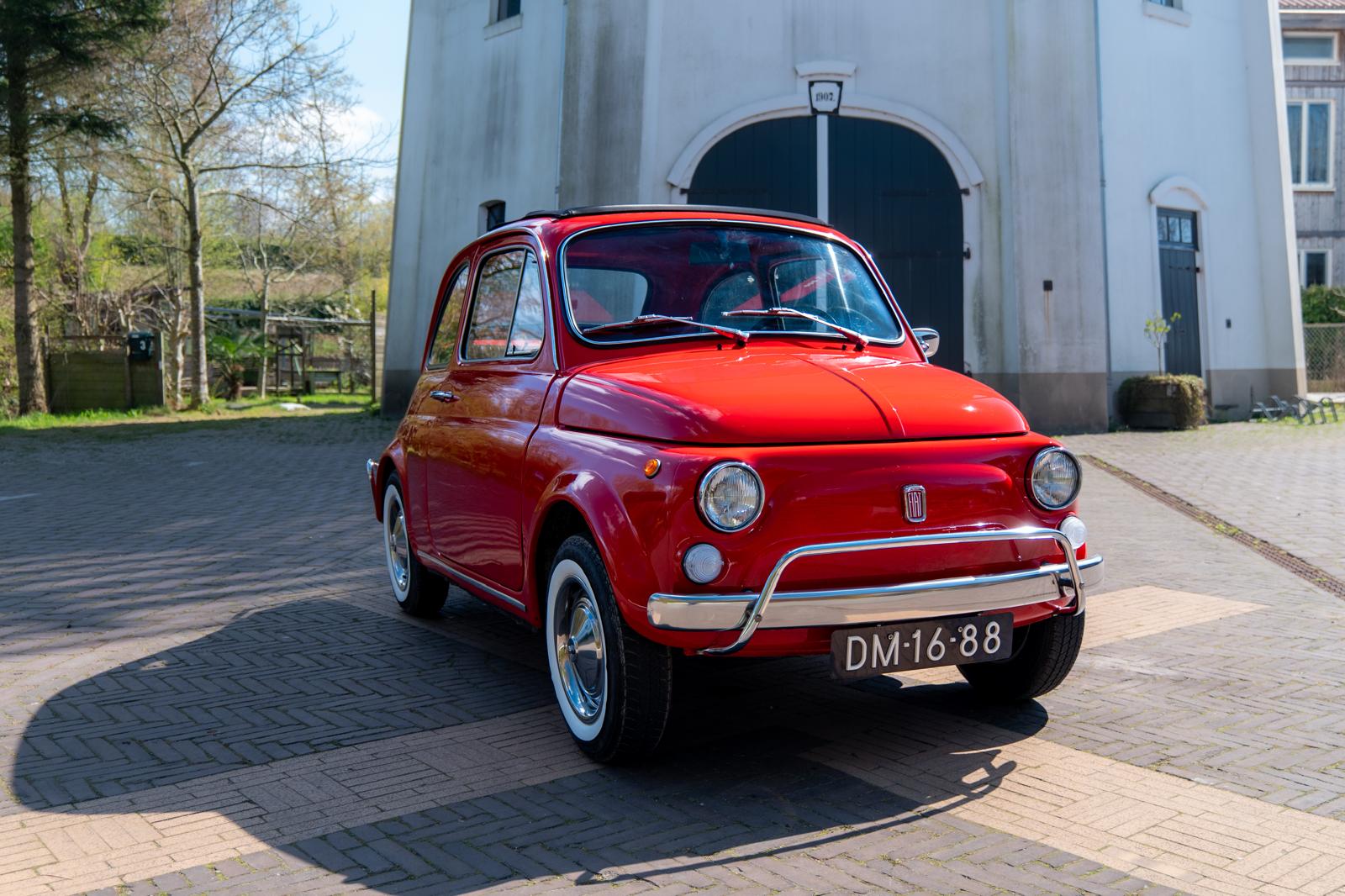
At Tonny’s Classic Drive in Groningen, we have three in total, all available for hire for a romantic drive, with or without a carefully planned route. In our collection you’ll find a white, green and red Fiat 500. And no, that’s not a coincidence. It’s the Italian flag. In this article, we dive deep into the history and development of the Fiat 500.
It’s almost impossible to imagine today, yet an entire family once fitted inside. That same family went on holiday in it, fully loaded with luggage. Not through the Gotthard Tunnel, but over the Grossglockner High Alpine Road. And the remarkable thing is that even today, if you’re 1.90 metres tall and weigh 90 kilograms, you’ll find it fits like a glove. And this isn’t the only way in which this little car proves itself to be truly great. There is only one car that quite literally and figuratively set an entire country back in motion while it was on its economic knees: the Fiat 500.
It is a sociological phenomenon, a masterpiece of industrial design, and the eternal symbol of the Italian soul. For visitors to Tonny’s Classic Drive, the Cinquecento is not a curiosity, but a rolling monument — a piece of technical ingenuity that deserves respect.
To truly understand the impact of this icon when you come face to face with our White, Red or Green Fiat 500, we must not start in the 1950s, but go back to the turbulent period between the two world wars. It was there that the dream of a “car for everyone” was born.
The Prologue: The Legacy of the Fiat Topolino (1936–1955)
Although the iconic rounded shape from 1957 is the car most people picture, the bloodline begins as early as the 1930s. Fascist dictator Benito Mussolini had an obsession: Italy had to be motorised. He summoned Senator Giovanni Agnelli, founder of Fiat, and demanded a car that would cost no more than 5,000 lire.
The task fell to the young and brilliant engineer Dante Giacosa. In 1936, he delivered the Fiat 500 A. Because of its small stature and headlights perched high on the fenders like little ears, the public affectionately nicknamed it the Topolino (“Little Mouse”).
The Topolino was a technical marvel, but essentially a “full-size car” in miniature. It featured a water-cooled four-cylinder engine mounted at the front, rear-wheel drive, and a separate chassis. After the Second World War, with Italy in ruins, it became clear that the Topolino (which had evolved into the C model) was too complex and too expensive to mobilise the masses. Production ended in 1955. The name “500” was briefly shelved, but the need for a true people’s car was greater than ever.
Project 110: The Birth of the Fiat 500 as a People’s Car
By the mid-1950s, Fiat faced a monumental challenge. Italians were desperate to drive, but their wallets simply wouldn’t allow it. The streets of Rome and Naples were dominated by Vespas and Lambrettas. Fiat needed to build a car that could compete with a scooter in terms of purchase price and running costs, while still offering protection from rain and cold.
Dante Giacosa, now promoted to Technical Director, began work on “Progetto 110.” His mission was radical simplicity. While the Fiat 600, launched in 1955, still used a water-cooled four-cylinder engine, Giacosa realised that the new 500 had to be even simpler. Every gram of steel and every single bolt counted in the cost calculation.
Why the Air-Cooled Twin-Cylinder Was a Brilliant Gamble
Giacosa made a decision that bordered on heresy within Fiat: he chose an air-cooled twin-cylinder engine. Until then, Fiat had sworn by water cooling, but air cooling offered decisive advantages:
Cost: No radiator, no water pump, no hoses, no thermostat, and no coolant.
Weight: Fewer components meant a lighter car, allowing for lighter suspension and smaller brakes.
Reliability: What isn’t there can’t break. In the hot Italian summers, hoses couldn’t leak and radiators couldn’t boil over.
The engine displacement was set at exactly 479 cc (later 499 cc). This was no coincidence, but a strategic decision based on Italian tax brackets of the time. The inline twin-cylinder engine was mounted at the rear. The block was cast iron, while the cylinder heads were aluminium to improve heat dissipation.
Technical Refinements
The cooling system was ingenious in its simplicity. A large fan, mounted directly on the crankshaft, continuously blew air over the cooling fins of the cylinders. With no thermostat to regulate cooling, the engine was cooled constantly whenever it was running.
Another characteristic you’ll notice when driving our White, Red or Green Fiat is the engine balance. The pistons move up and down together (360-degree crankshaft), producing that distinctive burbling sound — and more vibration than you’d expect from a four-cylinder. Fiat countered this with clever engine mounts, making it surprisingly comfortable in practice.
The Launch of the Fiat Nuova 500 (1957): From Criticism to Success
On 4 July 1957, the Nuova 500 (“New 500”) was launched in Turin under the watchful eye of Fiat CEO Vittorio Valletta. Expectations were high, but the reaction from press and public was a cold shower. Journalists mockingly described the car as “half a car for half the price.”
In its zeal to cut costs, Fiat had stripped the car too far. “Spartan” would be an understatement:
No rear seat: only a thinly padded shelf; the car was homologated as a two-seater.
Fixed windows: the side windows could not be opened.
Power: the engine produced just 13 hp, good for a top speed of 85 km/h.
Sales stagnated immediately. Italians preferred to save up for the 600. Fiat reacted quickly. In the autumn of 1957, the “Normale” was introduced, featuring opening windows, a proper rear seat, and slightly more power. From that moment on, sales took off — and would not stop for the next 18 years.
Driving a Classic Fiat 500: Engineering, Feel and Experience
Anyone who truly wants to experience the history of the Fiat 500 inevitably encounters the gearbox. This is where Dante Giacosa’s theory becomes the driver’s practice. Within our collection at Tonny’s Classic Drive, we see exactly the two technical variants that define the car’s evolution.
The Purist Experience (Crash Gearbox and Double Clutching)
The original Fiat 500 was delivered with a four-speed gearbox without synchromesh — technically known as a crash box. This is exactly what you’ll find in our White and Red Fiat 500s.
Without synchroniser rings to match gear speeds, the driver must do the work. Upshifting requires patience; downshifting requires technique. You need to master the art of “blipping the throttle,” or in Italian, the doppietta (double clutching):
- Clutch in, shift to neutral.
- Release the clutch.
- Give a quick blip of throttle (to bring the gears up to speed).
- Clutch in again and shift quickly into the lower gear.
Those who fail to master this in our White or Red lady are rewarded with a painful grinding noise of gears “polishing” each other. It turns driving into a craft — a physical skill completely lost in modern cars.
The More Modern Evolution
In later years (and with the successor, the Fiat 126), the technology was refined and synchronised gearboxes became available. This setup is found in our Green Fiat 500. Here, brass synchroniser rings take over the work for you, making driving far easier and more accessible without changing the character of the engine. It marks Fiat’s transition from “pure necessity” to “comfortable transportation.”
Technical Specifications of the Classic Fiat 500
Engine: 2-cylinder, air-cooled, rear-mounted
Displacement: 479–499.5 cc
Power output: approx. 13–18 hp (SAE) at 4,600 rpm
Top speed: approx. 85–95 km/h
Length: 2.97 metres
Weight: 500–550 kg
Gearbox: White & Red: non-synchronised • Green: synchronised
The Evolution of Fiat 500 Models (1957–1975)
Between 1957 and 1975, the 500 evolved in small but significant steps.
500 D (1960–1965): For many, the “holy grail.” Engine capacity increased to 499 cc. The roof was shortened; the canvas now ended above the passengers, with a fixed rear window. The 500 D retained the charming but unsafe suicide doors (rear-hinged doors).
500 F (1965–1972): The most-produced version. Under pressure from safety regulations, door hinges moved to the front (conventional doors). Chrome side trim disappeared and the interior was slightly modernised.
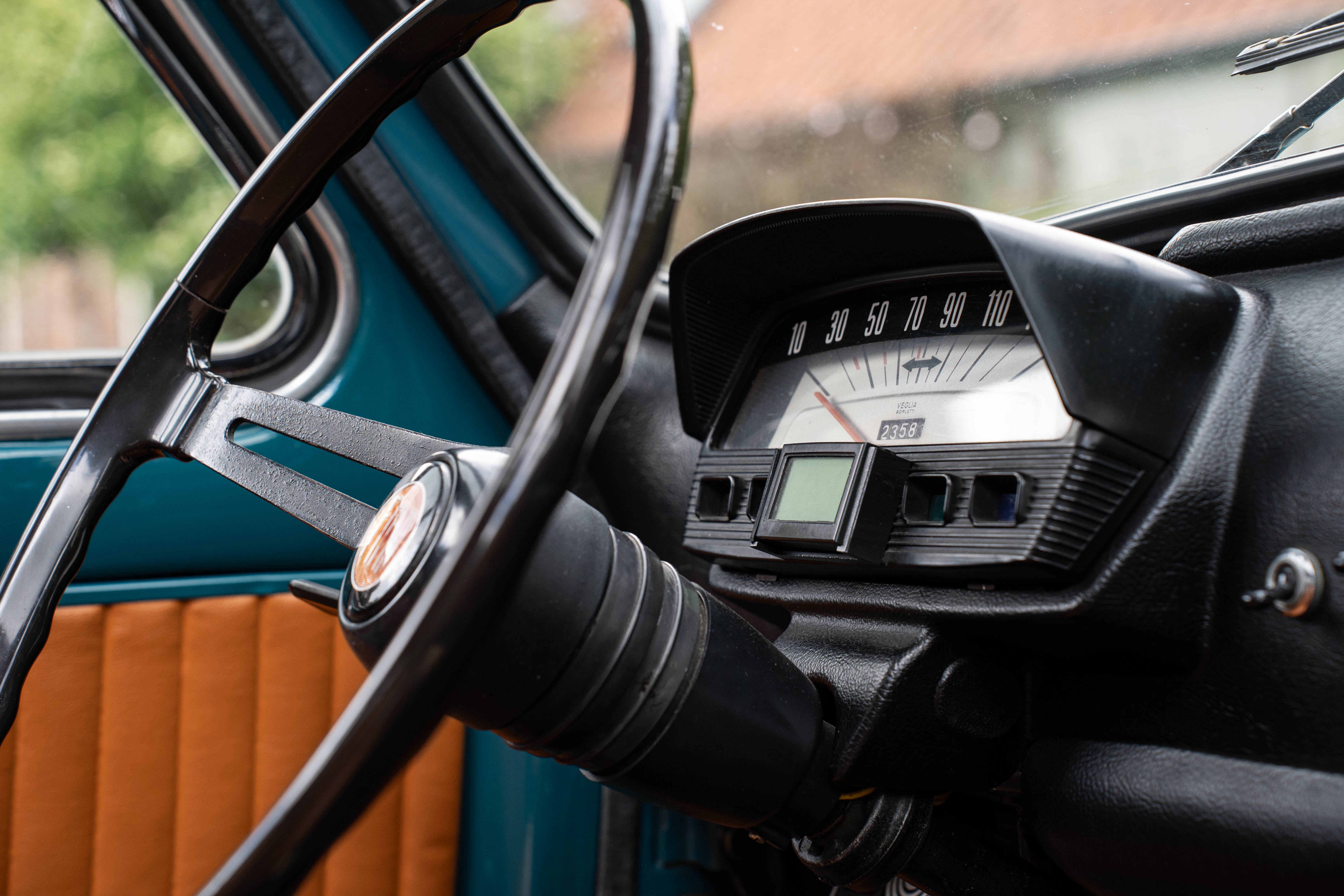
500 L – Lusso (1968–1972): Designed to appeal to more affluent buyers. Recognisable by extra chrome overriders on the bumpers (“whiskers”). The interior gained carpet, upholstered door panels, and a rectangular instrument cluster with fuel gauge.
500 R – Rinnovata (1972–1975): The swan song. A transitional model featuring the engine of the successor (Fiat 126) in the old body, without the Lusso’s chrome.
Fiat 500 Abarth: The Myth of the Scorpion
While Fiat focused on the masses, an Austrian-born engineer named Carlo Abarth saw something else in the little 500: a potential race car — a “David” capable of taking on the “Goliaths.”
Abarth transformed the standard 500 into a small monster. He bored out the cylinders to 595 cc and later 695 cc, polished intake and exhaust ports, fitted twin carburettors, and installed stiffer suspension. The result was astonishing. The Fiat Abarth 595 and 695 became legends on the racetrack.
The most iconic image of the Abarth 500 is the permanently open rear engine lid. This wasn’t an aesthetic choice, but a necessity. The tuned air-cooled engines ran so hot they needed extra cooling. Abarth also discovered that the open lid acted as a spoiler, improving aerodynamics and top speed. Although our White, Red and Green Fiat 500s are “civilised” versions, they carry the same DNA Abarth used to embarrass Porsche drivers on twisting circuits.
Special Coachbuilt Versions: From Fiat 500 Jolly to Coupé
The simple 500 platform inspired not only tuners, but also Italy’s most famous design houses (carrozzerie). They used the 500 chassis as a blank canvas for creative expression.
The most famous variant is undoubtedly the Fiat 500 Jolly, built by Ghia. Often called the “beach car,” it had no doors, but elegant cut-outs. The metal roof was replaced by a fringed fabric canopy, and the seats were made not of cloth or leather, but wicker. Why? So you could step straight in from the sea wearing a wet swimsuit without ruining the interior.
The Jollys were outrageously expensive (sometimes twice the price of a standard 500) and were purchased by the global elite. Aristotle Onassis, Yul Brynner and Grace Kelly used them on yachts or to parade around Monaco and Capri. It perfectly illustrates the 500’s versatility: a car for the factory worker in Turin and the billionaire’s toy on the Riviera.
Other builders created their own variations:
Francis Lombardi built the “My Car,” with a modified roofline and a more refined front.
Autobianchi (part of Fiat) used 500 mechanics for the Bianchina, a more upmarket city car available as both coupé and cabriolet.
International Success and Export of the Fiat 500
Although designed for narrow Italian streets, the 500’s success quickly spread beyond the peninsula. From 1958 onward, exports gained momentum. The car became especially popular in Germany, Austria and Switzerland, often as an economical second car for families.
Export markets required specific adaptations. In colder climates, the standard heater (which channelled warm air from the engine into the cabin) was often insufficient. Export models sometimes received an additional petrol heater from Webasto. Versions with fixed roofs or steel sliding roofs were also available. In the United States, Fiat tried the Fiat 500 America, fitted with oversized headlights (“frog eyes”) to meet US regulations, but in the land of V8 engines, the twin-cylinder was rarely understood.
The Fiat 500 in Pop Culture and La Dolce Vita
In the 1960s and 1970s, the Fiat 500 became an inseparable part of Italian street life and pop culture. Films such as La Dolce Vita and Il Sorpasso featured the car in the background as a symbol of modern Italy.
In Japan, the car achieved cult status thanks to the anime series Lupin III, in which the master thief drives a canary-yellow Fiat 500. In Italy itself, TV commercials aired during the legendary Carosello programme became iconic. The slogan “La Fiat 500: piccola sì, ma con tanta grinta” (“The Fiat 500: small, yes — but full of spirit”) became a catchphrase. The car was no longer just transportation; it became family.
The End of the Classic Fiat 500 and the Arrival of the Fiat 126
In 1972, Fiat introduced the 126 as the successor. Technically, it was almost identical to the 500 (same engine, same wheelbase), but wrapped in a more angular, modern body suited to the 1970s. Fiat expected sales of the 500 to collapse immediately.
That didn’t happen. The public loved the rounded lines of the 500 and found the 126 dull by comparison. Fiat therefore continued producing the 500 (as the R model) alongside the 126 for another three years. On 1 August 1975, the very last classic 500 rolled off the production line at the factory in Sicily. The final count stood at exactly 3,893,294 units.
Conclusion: Why the Classic Fiat 500 Brings an Eternal Smile
Why has the love for this little “backpack” endured for more than 80 years? Because the car is classless. You can park a Fiat 500 outside a student house or a chic hotel in Portofino, and in both cases you’ll be greeted with a smile.
Dante Giacosa was tasked with creating cheap transportation. He failed to build a cold machine; instead, he created a car with a soul. That soul vibrates in our White and Red 500s with their authentic gearboxes, and smiles calmly from our Green version. As long as there are narrow streets in Italy — and in Groningen — and as long as people want to smile behind the wheel, the classic Cinquecento will keep driving. Proof that you don’t have to be big to be great. Fiat 500 enthusiasts gather in the Fiat 500 Club, which organises around 20 Fiat 500 events every year and also provides technical advice. Highly recommended. Don’t own a Fiat 500 yourself but would love to experience one in the north of the Netherlands, without the burden of maintenance — just pure enjoyment? Hire one of our Fiat 500s from the Tonny’s Classic Drive collection in Groningen and experience it for yourself. Watch our video of the green Fiat 500 on our YouTube channel.