The Austin Mini: How a Small Box Changed the World
There are cars that transport people, and there are cars that move history. The classic Mini unquestionably belongs to the latter category. When it was presented to the public in 1959, it wasn’t just a new model; it was a radical break from everything people knew about automotive engineering. It was a car small enough to fit sideways in a parking space, yet large enough to carry four adults and their luggage. It was the car that broke down class barriers, won rallies against far more powerful sports cars, and became the symbol of the 'Swinging Sixties'. In this deep dive into the history of the Mini, we discover how a crisis led to a stroke of genius, how Sir Alec Issigonis seemed to bend the laws of physics, and why this small British icon remained in production for more than forty years.
Rent an Austin Mini classic car in Groningen
Do you want to not only read about this legend, but experience it for yourself? With us, you can rent an Austin Mini classic car in Groningen for a day trip, a weekend, a photoshoot, or a special occasion. We are a classic car rental company with a large collection, so if the Mini doesn’t fit your plans, there is always an alternative with the same classic feel.
The Origins: Born Out of Crisis
To understand the Mini, we have to go back to 1956. Great Britain was in dire straits due to the Suez Crisis. The supply of oil came under severe pressure, fuel prices shot up, and rationing was introduced. Suddenly, microcars—so-called 'bubble cars' like the Isetta and the Messerschmitt—appeared on British roads. They were economical, but also noisy, uncomfortable, and often dangerously unstable. Leonard Lord, the head of the British Motor Corporation (BMC), loathed them. He wanted these "damned bubble cars" off the road, but realized he had to offer a better alternative.
His instruction to his chief engineer, Alec Issigonis, was simple but uncompromising: design a real car with four wheels that fits in a box measuring 3 by 1.20 by 1.20 meters (10x4x4 feet). And more importantly: 80% of that space had to be reserved for passengers and luggage.
The Vision of Alec Issigonis
Issigonis was not an ordinary engineer; he was a visionary who put functionality above all else. He disliked styling purely for decoration and believed that engineering should determine form. With a small team, including Jack Daniels (not the distiller) and Chris Kingham, he withdrew to make the impossible possible.
A Technical Masterpiece: The Blueprint for the Modern Car
What made the Mini so revolutionary was not one specific component, but the combination of radical engineering choices. Before 1959, most cars had the engine in front, a gearbox behind it, and a driveshaft running to the rear wheels. This took up an enormous amount of space.
Issigonis completely turned this concept on its head:
- Transverse Engine: He took the existing BMC A-Series engine and rotated it a quarter turn, so it sat transversely between the front wheels.
- Gearbox in the Sump: Because there was no room for a gearbox next to the engine, Issigonis placed it underneath the engine, in the oil sump. As a result, the engine and gearbox shared the same oil.
- Front-Wheel Drive: Although not new (Citroën had already successfully applied this with a longitudinal engine), the combination with a transverse engine was unique for mass production. It completely eliminated the transmission tunnel from the interior.
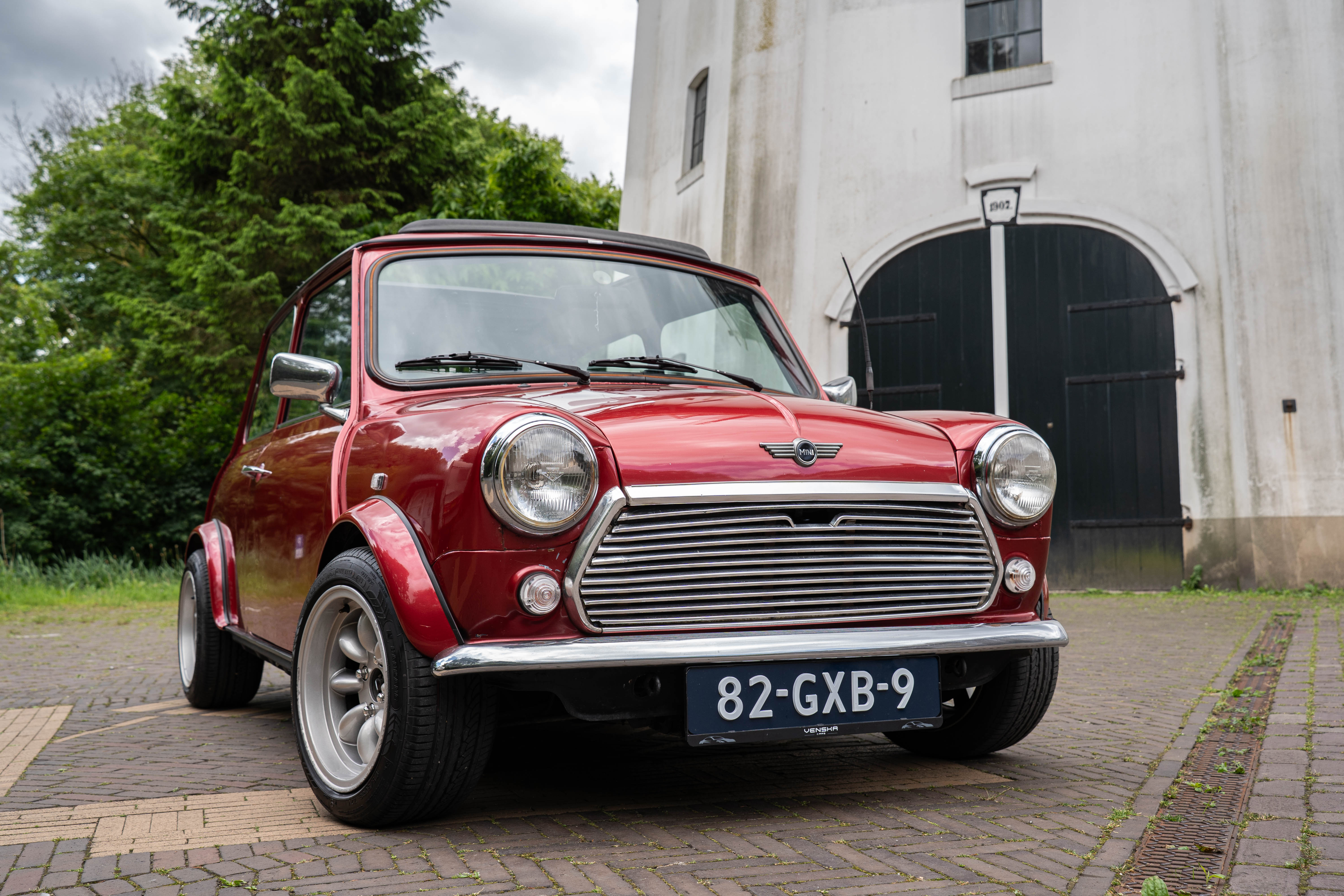
- Wheels at the Corners: To maximize interior space, the small 10-inch wheels were placed at the extreme corners of the body.
The Suspension: From Cones to Fluid and Back Again
Conventional steel springs took up too much space. Issigonis enlisted the help of his friend Dr. Alex Moulton. Moulton developed a suspension based on compact rubber cones instead of springs. This gave the Mini its legendary, firm 'go-kart' handling.
However, there was a period—between 1964 and 1971—when the Mini took on a slightly different character. This was the era of Hydrolastic suspension. Instead of the familiar rubber cones, the wheels were suspended by fluid-filled chambers connected front and rear via pipes. When the front wheels hit a bump, the fluid moved through the system, causing the front and rear axles to influence each other and making body movements much calmer. The result was a level of comfort that was unique for a car of this size.
Ingenious as it was, the system proved more expensive and complex to produce. After 1971, they therefore returned to the original, reliable rubber cones (dry suspension). Less comfortable, but more direct, cheaper, and loved by sporty drivers.
The Launch: Austin Seven and Morris Mini-Minor
On 26 August 1959, the car was unveiled. Because BMC was a merger of different brands, the car was released under two names:
- The Austin Seven (sold by Austin dealers).
- The Morris Mini-Minor (sold by Morris dealers).
At first, the public was skeptical. The car looked strange, the wheels seemed too small, and the seating position was, to put it mildly, unusual (slanted behind the steering wheel, similar to a bus driver).
In addition, there were teething problems. The body was not watertight, turning floor mats into sponges in the rain. Still, the price was unbeatable: £496.
Innovative Savings
Issigonis' obsession with space and cost led to unique details:
- Door Seams: The body weld seams were on the outside (the familiar 'flange edges'), which made assembly cheaper and saved interior space.
- Sliding Windows: Instead of roll-down windows, the car got sliding windows. This allowed the doors to remain hollow, creating space for enormous storage bins. The story goes that these bins were exactly large enough for Issigonis' favorite gin bottle.
- Boot: The lid hinged downward and could remain open while driving, artificially increasing the loading space.
The 1960s: From Grocery Car to Icon
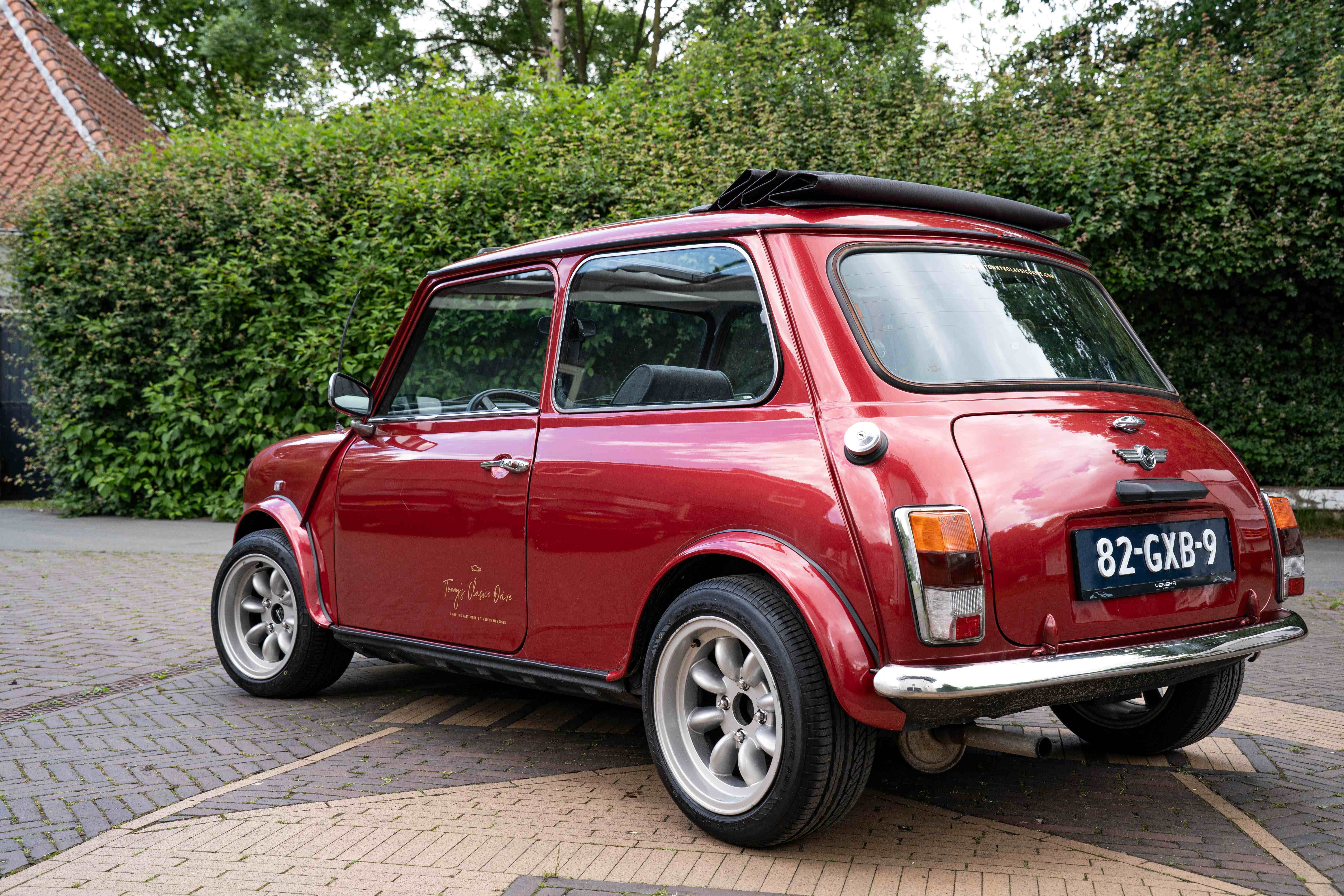
The Mini started as a car for the ordinary person, but in the 1960s something magical happened. The car became “classless”. Lord Snowdon, the husband of Princess Margaret, was one of the first to buy a Mini. Suddenly, members of the royal family were seen driving the same car as the postman. It became a fashion item. Everyone who mattered in Swinging London had to have a Mini: The Beatles, Peter Sellers, Twiggy, and Steve McQueen. Fashion designer Mary Quant loved the car so much that she named her most famous creation—the short skirt—after it: the miniskirt. The Austin Mini became more than transportation; it was a statement of modernity, youthfulness, and British independence.
The Cooper Connection: David Defeats Goliath
While Issigonis saw the Mini as a purely utilitarian means of transport, his friend John Cooper (owner of the Cooper Formula One team) saw something else: a race car. Cooper saw how agile the car was and convinced BMC to build a sporty version. In 1961, the Mini Cooper appeared, with a bored-out engine, twin carburetors, and front disc brakes. The pinnacle was the Cooper S. This car dominated rallying in a way no one thought possible. The small Mini took on the brute force of Ford V8s and Porsches on the snowy roads of the Monte Carlo Rally.
The Monte Carlo Legend
The victories in Monte Carlo are heroic David-versus-Goliath stories. The Mini Cooper S took on far more powerful competitors such as the Mercedes-Benz 300 SE and the Ford Falcon. The legendary "Night of the Long Knives" on the Col de Turini was often decisive. On 21 January 1964, the Mini made history when Paddy Hopkirk and co-driver Henry Liddon, with start number 37 and the now-famous registration 33 EJB, took the win. The success was repeated in 1965 when the flying Finn Timo Mäkinen won, and in 1967 when Rauno Aaltonen triumphed. Together, these three drivers became known as the "Three Musketeers" of rallying. The 1966 edition is perhaps the most notorious. Minis finished in 1st, 2nd, and 3rd. However, the French jury disqualified the British cars because of a trivial detail about the headlamp bulbs. The victory was awarded to Citroën, but the moral victory belonged to Mini. The controversy only made the car more popular.
Evolution and Variants: A Mini for Everyone
During its long life, the Mini underwent various changes and countless variants appeared.
The Marks (Generations)
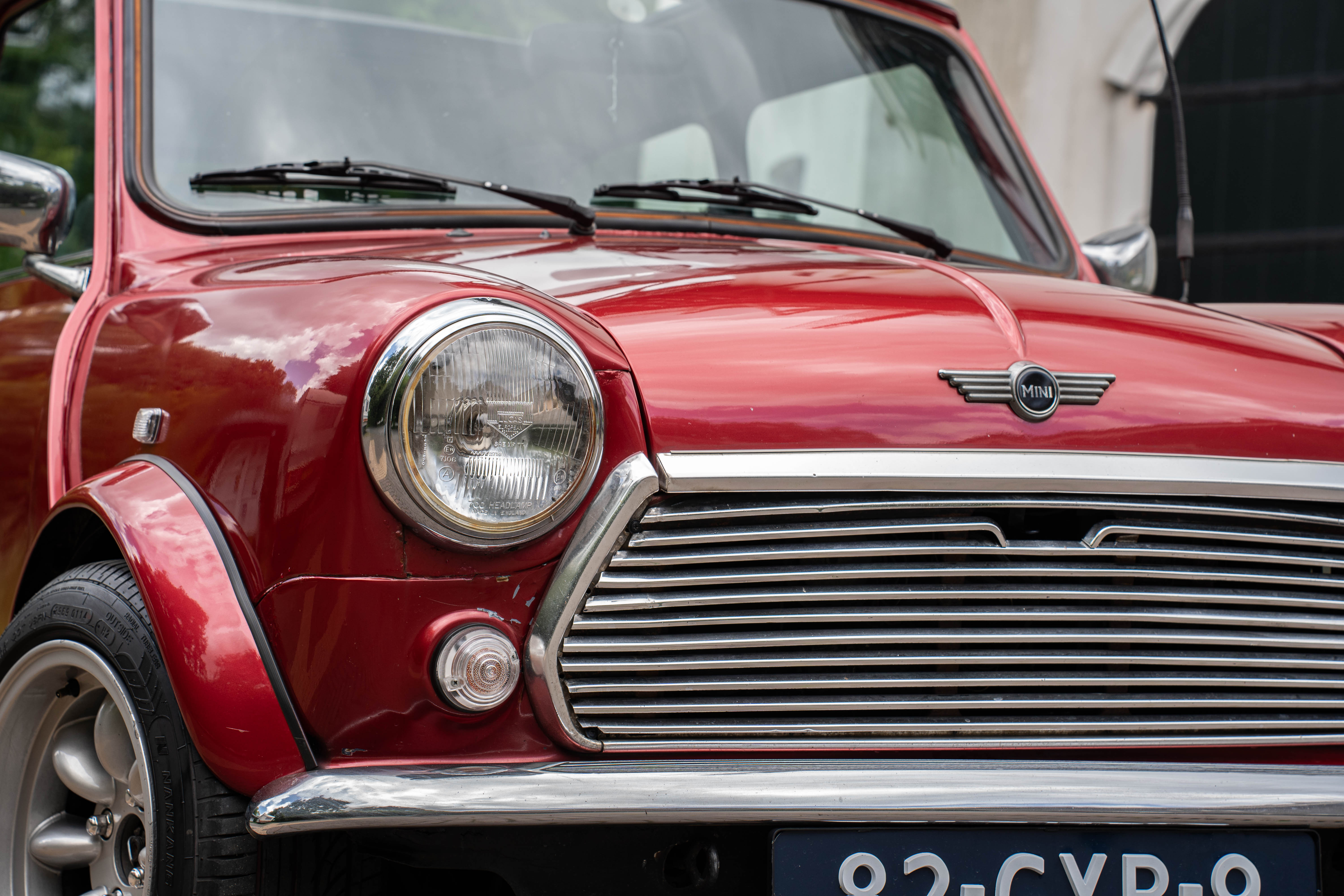
- Mk I (1959-1967): The original version with the 'moustache grille', sliding windows, and external door hinges. This is the most sought-after version for collectors.
- Mk II (1967-1970): A small facelift with a more angular grille and a larger rear window.
- Mk III (1969-1976): A major change. The external door hinges disappeared (for safety) and roll-down windows were introduced. The names 'Austin' and 'Morris' largely disappeared; it became simply 'Mini'.
The Family
BMC fully milked the platform:
- Traveller & Countryman: Estate cars with the characteristic wooden frames on the outside.
- Van & Pick-up: Commercial vehicles on an extended chassis.
- Mini Moke: Originally intended as a light military vehicle that could be dropped by parachute. The army rejected it (too little ground clearance), but it became a cult beach car.
- Wolseley Hornet & Riley Elf: Luxury versions with a traditional, upright grille and an attached boot (the “tail”).
The Difficult Years: British Leyland and the Clubman
In the 1970s and 1980s, the British car industry was plagued by mergers, strikes, and mediocre quality. BMC became British Leyland (BL). BL management did not understand the Mini well. They found it outdated and expensive to produce. In 1969, they tried to modernize the Mini with the Mini Clubman. It had a square nose (designed by Roy Haynes) that made it look more like a “normal” car and offered better crash safety. The 1275 GT replaced the Cooper S as the sporty model. Although the Clubman sold reasonably well, purists continued to prefer the classic round nose. Ultimately, the original design outlived the “modern” Clubman, which was discontinued in 1980.
The Metro Threat
In 1980, Austin launched the Metro. This car was intended as the successor to the Mini. The expectation was that Mini production would stop quickly. But the market decided otherwise. The Mini remained popular, especially in Japan (where the car gained enormous cult status) and as a trendy city car in Europe. British Leyland, and later the Rover Group, had no choice but to keep building the 'golden oldie'.
The Rebirth and the End (1990-2000)
In the 1990s, the Mini experienced a surprising renaissance. Under the Rover Group, the car was repositioned not as cheap transport, but as a premium classic.
- Luxury and Comfort: The spartan interiors of earlier years made way for walnut wood, leather upholstery, and better sound insulation.
- Safety: In the late 1990s, the Mini even received an airbag in the steering wheel and reinforcement bars in the doors to meet modern requirements.
The Arrival of Injection (SPI & MPI)
Under the bonnet, the Mini was also forced to grow up. The era of the chugging carburetor came to an end due to increasingly strict emissions requirements. In the early 1990s, SPI (Single Point Injection) was introduced, followed from 1996 by the more advanced MPI (Multi Point Injection). Together with the mandatory catalytic converter, this ensured that the classic Mini became cleaner and more economical, without losing its characteristic driving feel.
The Definitive End
When BMW took over the Rover Group in 1994, the Germans immediately saw the value of the Mini brand. While they worked on a completely new generation (the New MINI), they kept the classic alive. On 4 October 2000, the very last classic Mini rolled off the line in Longbridge. It was a red Cooper Sport. After 41 years and 5,387,862 examples, the curtain fell on the car that had actually been intended for only ten years.
Why the Mini Is Still Relevant Today
If we look back now, decades later, we see the immense legacy of the Austin Mini.
- Technical Standard: Look at almost any modern compact car (Volkswagen Golf, Ford Fiesta, Renault Clio). They all use the layout Issigonis perfected: transverse engine, front-wheel drive. The Mini is the grandfather of the modern hatchback.
- Driving Pleasure: In an era of heavy, electronically controlled cars, a classic Mini offers an analog driving experience that has become rare. You feel the road, you work hard at the wheel, and every drive puts a smile on your face.
- Likeability: A classic Mini doesn’t provoke aggression. If you drive a Ferrari, people sometimes look jealous or disapproving. In a Mini, people wave at you. It’s one of the few cars that is universally loved.
Conclusion
The Austin Mini was a brilliant answer to a difficult question. Alec Issigonis designed a car out of necessity, but unintentionally created a legend. It was a car full of contradictions: small on the outside but big on the inside, cheap yet driven by millionaires, and cute yet unbeatable on the track. The classic Mini is not just old iron; it is a piece of cultural heritage that teaches us that good design is timeless. Whether you know it as the Austin Seven, Morris Mini-Minor, or simply 'the Mini', its place in the history books is bigger than its dimensions could ever suggest.
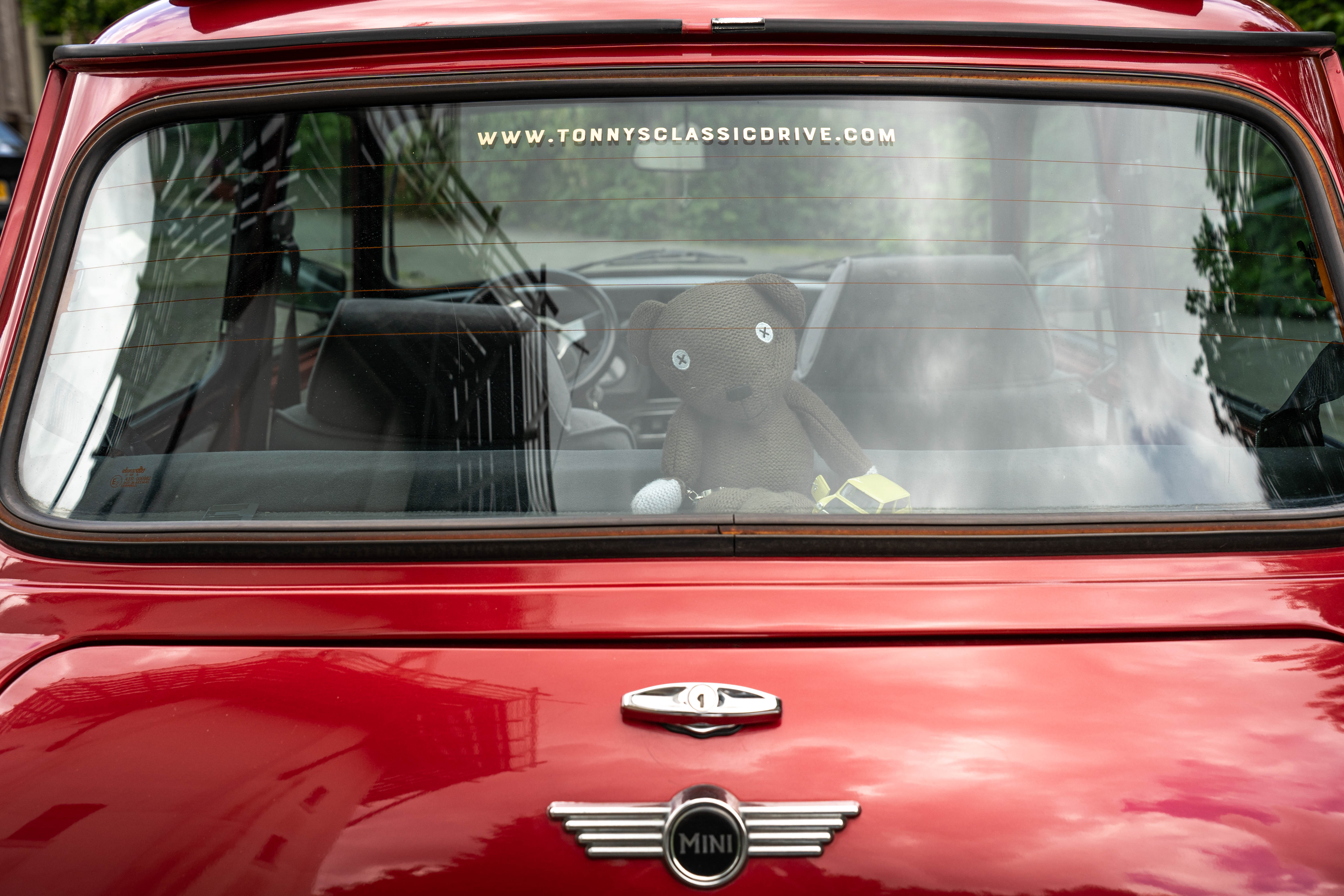
Rent a Mini classic car in Groningen, come enjoy a day out
It’s always a good idea to go for a day tour in a classic car. For example, for a day or part of a day, or as a gift for a friend!
- For whom: day trip, weekend away, photoshoot, wedding, gift experience.
- Pick-up & region: Groningen (and the North of the Netherlands).
- Alternatives: large classic car collection available.