Citroën 2CV6 (1970–1990): History, Engineering and Evolution of the Iconic 2CV
Dec 15, 2025 • 15 minutes reading time
Citroën 2CV6 (1970–1990): History, Engineering and Evolution of the “Ugly Duckling”
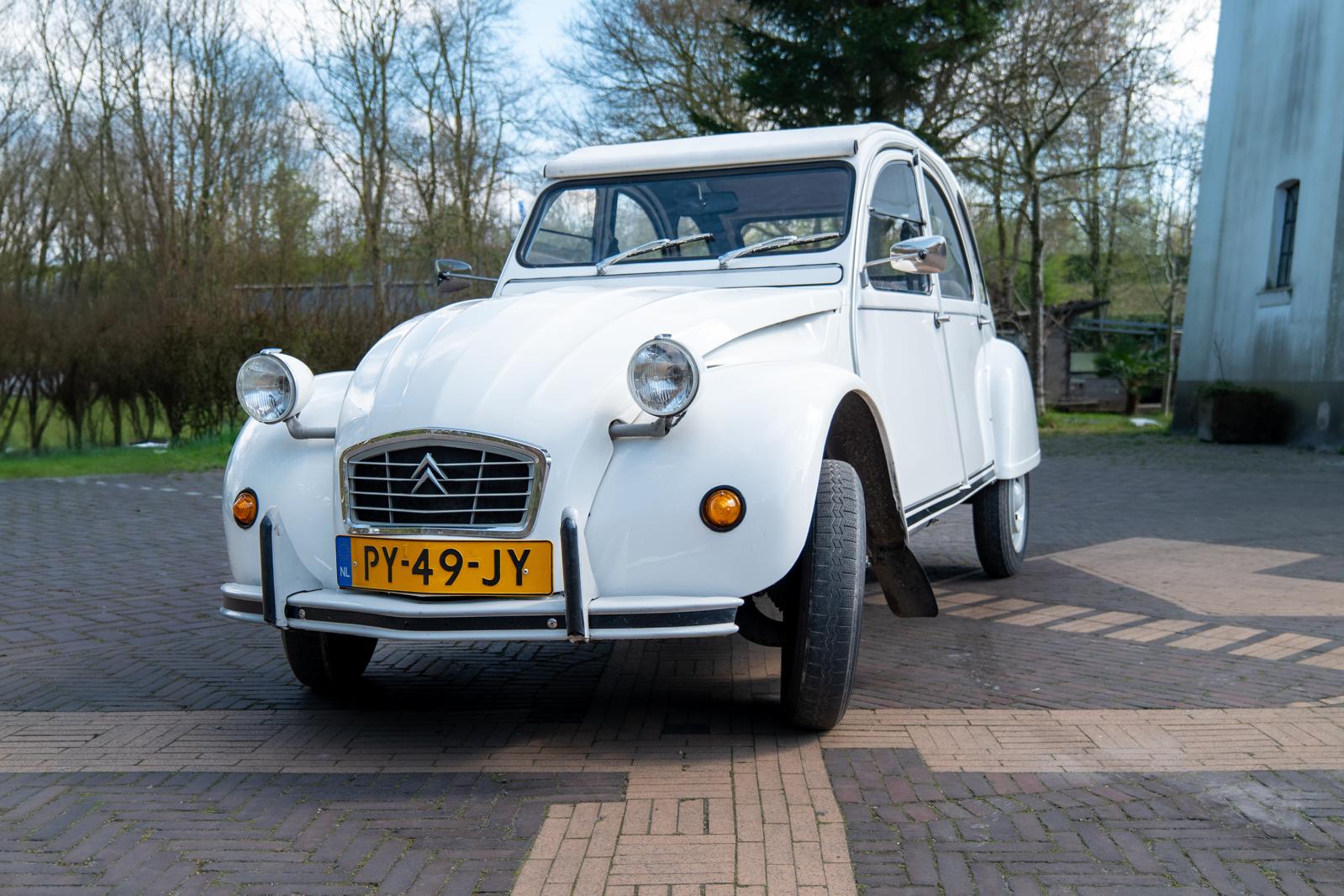
In this in-depth article, you will read the complete and historically accurate story of the Citroën 2CV6 and understand why we at Tonny’s Classic Drive in Groningen have added a beautiful white 2CV6 Club from model year 1986 to our rental collection. The 2CV6 is the most mature version of the legendary “Ugly Duckling”. We dive into the origins of the TPV project (Toute Petite Voiture), the introduction of the 602 cc engine in 1970, the technical layout of the engine, suspension and gearbox, and both the visible and hidden evolutions over the years. Special editions such as the Charleston, Dolly and 007 are discussed in detail, as well as the end of production in France and Portugal. Finally, we place the 2CV6 in a modern-day context and explain why this model remains so relevant and beloved today.
The Citroën 2CV6 as a cultural and technical icon
The Citroën 2CV, affectionately known as the “Ugly Duckling” in the Netherlands or the “Goat” in Belgium, is far more than just a car; it is a piece of cultural heritage and a symbol of French ingenuity. Although the 2CV lineage began in 1948, the 2CV6 represents the most mature, powerful and usable evolution of this concept. Where early models were spartan and slow, the 2CV6 brought the car into the modern era, keeping it relevant well into the 1980s.
In this article we take a deep dive into history, with a specific focus on the 2CV6. Introduced in 1970, it defined the face of the model until the final production run in 1990. Below you can watch a video of our 2CV6 Club. You’ll find more videos like this on our Tonny’s Classic Drive YouTube channel — subscribe right away!
The origins of the Citroën 2CV6: from TPV to a global phenomenon
Want to understand the 2CV6? Then we must return to its roots. The concept originated in the 1930s under the leadership of Pierre-Jules Boulanger, then director of Citroën. His vision was radical yet simple. He commissioned the TPV project (Toute Petite Voiture) with a now legendary set of requirements:
“Design a car that can carry two farmers and a 50-kilogram sack of potatoes at a speed of 60 km/h, and that is so comfortably sprung that a basket of eggs remains intact while driving across a ploughed field.”
Aesthetics did not matter; functionality was everything. After the prototypes were hidden from the German occupiers during the Second World War, the 2CV was finally unveiled at the Paris Motor Show in 1948. The press was critical, calling it a “tin opener on wheels,” but the public understood its brilliance. The 2CV mobilised post-war France.
The first models were powered by a tiny 375 cc engine producing just 9 hp. Throughout the 1950s and 1960s, displacement grew to 425 cc (the 2CV AZ), but the call for more power — needed to keep up with increasingly busy traffic — grew louder. This ultimately led to the birth of the 2CV6.
The introduction of the Citroën 2CV6 in 1970
In 1970, Citroën took a new direction to face growing competition, particularly from the Renault 4, which was more practical and faster than the older 2CV models. Citroën thoroughly reorganised its range.
Two new models were introduced to replace the old 2CV AZ:
- The 2CV4: equipped with a 435 cc engine.
- The 2CV6: equipped with the 602 cc engine (type M28/1).
The arrival of the 2CV6 changed everything. The engine was sourced from the more upmarket Citroën Dyane 6 and Ami 6. Although 602 cc may seem microscopically small by today’s standards, it represented a huge step forward compared to earlier models.
The electrical system of the 2CV6: from 6 to 12 volts
A crucial change that is often overlooked, yet essential for daily usability, was the transition from a 6-volt to a 12-volt electrical system. Where the old 6V systems often suffered from weak lighting and poor cold starting, the 12V system of the 2CV6 provided far more reliable starting and headlights that genuinely illuminated the road.
Specifications of the 2CV6 at launch
Early versions of the 2CV6 produced approximately 28.5 SAE hp (later measured as 29 DIN hp). This allowed the car to cruise at around 100 km/h and, with a tailwind and plenty of patience, reach a top speed of approximately 110 to 115 km/h. For the first time, this made the car truly usable on motorways and for holidays to the south — a ritual undertaken by many Dutch families.
Externally, the 2CV6 initially differed little from the 2CV4, apart from the badge on the rear and often a slightly more luxurious interior finish.
Engineering of the Citroën 2CV6: engine, suspension and drivetrain
The 2CV6 is praised for its brilliant simplicity. The engineering was designed so that maintenance could be carried out with minimal tools.
The 2CV6 engine: the boxer
At the heart of the 2CV6 lies the air-cooled two-cylinder boxer engine (flat twin).
- Construction: The engine features an aluminium-alloy crankcase and cast-iron cylinders. Because there is no radiator, water pump or thermostat, these components cannot fail.
- Cooling: A large fan on the crankshaft blows air through a duct over the cylinders and the oil cooler. This system is highly effective; a well-maintained 2CV6 rarely overheats. However, with neglected maintenance (such as a dirt-encrusted engine or a clogged oil cooler), the engine can indeed overheat in summer traffic or traffic jams.
- Sound: The characteristic chugging sound is iconic and caused by the specific firing order and air cooling.
Compared to the 2CV4, the 2CV6 was further distinguished by a two-stage carburettor. This resulted in slightly higher fuel consumption but provided the necessary extra power at higher speeds.
Suspension and chassis of the 2CV6
The suspension of the 2CV6 is unique and contributes to its legendary comfort (and its notorious body roll in corners).
- System: The front and rear wheels on each side are interconnected via a horizontal spring canister mounted beneath the car (longitudinally). When the front wheel hits a bump, the spring compresses and, via pull rods, also influences the rear wheel. This prevents nose dive and keeps the body more level over rough terrain.
- Shock absorbers: The transition of the damping system was gradual. Early models still used friction dampers and the famous inertia dampers (“batteurs”) at the wheels. During the 1970s, Citroën fully transitioned the 2CV6 to modern telescopic hydraulic shock absorbers, making handling tighter and more predictable.
The gearbox of the 2CV6
The gear lever protrudes from the dashboard like an umbrella handle.
- The shift pattern is unique: first gear is “backwards” (left and back), reverse is left and forward. Second, third and fourth gears follow a conventional H-pattern.
- The gearbox is mounted ahead of the engine, directly behind the bumper, making the car vulnerable in frontal collisions but benefiting weight distribution (front-wheel drive).
2CV6 brakes: from drum brakes to disc brakes
A major evolution within the 2CV6 range took place in 1981. Until then, the 2CV6 was equipped with drum brakes all round. From model year 1982 (starting in the summer of 1981), the 2CV6 received disc brakes on the front wheels. These were mounted inboard, near the gearbox, rather than at the wheels themselves, significantly reducing unsprung weight.
Due to the heat generated by these inboard discs, and the desire for a more reliable hydraulic system, Citroën simultaneously switched to green LHM (Liquide Hydraulique Minéral) fluid. LHM has a higher boiling point than standard brake fluid and is not hygroscopic (does not absorb moisture), making the braking system less maintenance-intensive and preventing corrosion in the lines.
Exterior evolution and equipment of the Citroën 2CV6
The 2CV6 retained its basic shape throughout production but underwent subtle changes that allow enthusiasts to identify the model year at a glance.
1970s: square headlights and rust
In 1974, the 2CV received a facelift. The round headlights were replaced by rectangular units from manufacturer Cibié. The grille also became plastic and adopted a new pattern. Many felt this detracted from the car’s charm, but it aligned with the angular design trends of the 1970s. During this period, the 2CV6 was often delivered in bright, typically 1970s colours such as Jaune Cédrat (lemon yellow) and Orange Ténéré.
A major concern with models from this era is rust. The steel used in the 1970s was often of lower quality, and factory rust protection was minimal. The chassis and footwells are particularly notorious weak points for these years.
1980s: a return to the classic look
In the 1980s, nostalgia for the “original” Duck emerged.
Citroën 2CV6 Club vs. 2CV6 Spécial: The range was split. The 2CV6 Spécial became the entry-level model (often without the third side window in the C-pillar in the early years, later with it, and featuring the old round dashboard from the 1960s). The 2CV6 Club was the more luxurious variant, with rectangular headlights, richer upholstery and a larger, square instrument panel.
Eventually, the rectangular headlights largely disappeared again in favour of round, often chrome-plated units, especially on special editions.

Special editions of the Citroën 2CV6
In the early 1980s, sales figures declined. The car was technically outdated. To stimulate demand, Citroën introduced a series of successful special editions (“séries limitées”) based on the 2CV6.
The 2CV6 Charleston (1980)
This is perhaps the most famous version. Originally intended as a limited run of 8,000 units in red and black (Rouge Delage and Noir), the car featured an Art Deco-inspired appearance drawn from the 1920s and 1930s.
Features: Two-tone paint with a distinctive curved line on the doors, round chrome headlights and chrome wheel trims.
Success: The model proved so popular that it was added to the regular production range in 1981. Later colour combinations included yellow/black and two shades of grey (Gris Cormoran / Gris Nocturne).
The 2CV6 007 (1981)
Following the appearance of a bright yellow 2CV in the James Bond film For Your Eyes Only, Citroën released a special edition.
Features: Bright yellow (Jaune Hélios), with large “007” logos on the doors and bonnet, plus decals depicting bullet holes.
Rarity: Today, this is one of the most sought-after collector’s items.
The 2CV6 Dolly (1985)
The Dolly targeted a younger, often female audience and introduced fresh two-tone colour schemes in a fixed pattern.
Combinations: White/grey, white/green, beige/red, and later additional variations. The Dolly models were based on the simpler 2CV6 Spécial, but their colour schemes gave them a chic appearance.
Other editions
There were numerous other versions, such as the France 3 (or Beachcomber in export markets) with nautical blue-and-white striping to celebrate French participation in the America’s Cup, and the Cocorico (blue-white-red).
The end of Citroën 2CV6 production (1988–1990)
Despite its charm and special editions, time eventually caught up with the 2CV6. Safety requirements became stricter, emissions standards tightened, and production costs were relatively high because assembly of the 2CV could hardly be automated — it remained largely hand-built.
France stops: In February 1988, the last 2CV rolled off the production line at the historic Levallois-Perret factory near Paris, marking the end of French production.
Portugal takes over: Production was fully transferred to the Mangualde factory in Portugal. In the final years, mainly the Charleston and Spécial models were built here. There remains ongoing debate among enthusiasts about the quality of these Portuguese-built Ducks. Although the technology remained identical, it is often claimed that rust protection and paint thickness were less consistent than in France, paradoxically causing some later models to rust faster than their predecessors.
The final day
On 27 July 1990, at 4:00 pm, the very last 2CV rolled off the production line in Mangualde. It was a Charleston finished in two shades of grey (Gris Cormoran / Gris Nocturne).
Production ended after 42 years. In total, more than 3.8 million 2CV saloons were produced. Including the van versions (AK, AZU, AKS) and derivatives (Dyane, Ami, Méhari), the total rises to nearly 9 million vehicles built on the A-type platform.
The Citroën 2CV6 today: relevance and lasting significance
Today, the 2CV6 may be more popular than it was in its final production years. It has become a true cult object. It is no coincidence that there is an active 2CV Club in the Netherlands, where enthusiasts can participate in a wide range of enjoyable activities.
Why the 2CV6 remains historically relevant:
- Antithesis of the modern car: In an era of complex electronics and autonomous systems, the 2CV6 stands for mechanical purity and self-reliance.
- Sustainability: A 2CV6 weighs only about 560 kg. Fuel consumption (averaging around 1 in 15 to 1 in 18) remains acceptable by modern standards, and the production footprint was minimal. Many parts are still reproduced today, allowing these cars to be kept alive indefinitely.
- Social equaliser: Just as in 1948, the 2CV6 bridges social classes. A lawyer waves to a student; in a Duck, everyone is equal.
Consistency in design:
What makes the 2CV6 so special is its faithfulness to Boulanger’s original concept. Although the engine in the 2CV6 was far more powerful than the original and the brakes were improved, the essence — a comfortable, simple means of transport beneath a “parasol” — remained intact down to the very last bolt. In short, the 2CV6 represents the ultimate expression of this concept. If you would like to learn more about the engineering and restoration of the 2CV, we recommend the book “Handboek 2CV” by Jan van der Velde.
Specifications: Citroën 2CV6 Club (1986)
- Engine: 602 cc air-cooled two-cylinder boxer (type M28/1)
- Power: 29 hp (DIN) at approx. 5,750 rpm
- Torque: approx. 39 Nm
- Drivetrain: front-wheel drive
- Transmission: 4-speed manual gearbox
- Top speed: approx. 110–115 km/h
- Brakes: front inboard disc brakes, rear drum brakes
- Electrical system: 12 volt
- Suspension: interlinked front and rear wheels per side with horizontal spring canisters
- Curb weight: approx. 560 kg
- Length: approx. 3,830 mm
- Width: approx. 1,480 mm
- Wheelbase: approx. 2,400 mm
- Fuel consumption: average approx. 1 in 15 to 1 in 18

Why we at Tonny’s Classic Drive added a beautiful white 2CV6 Club to our rental fleet
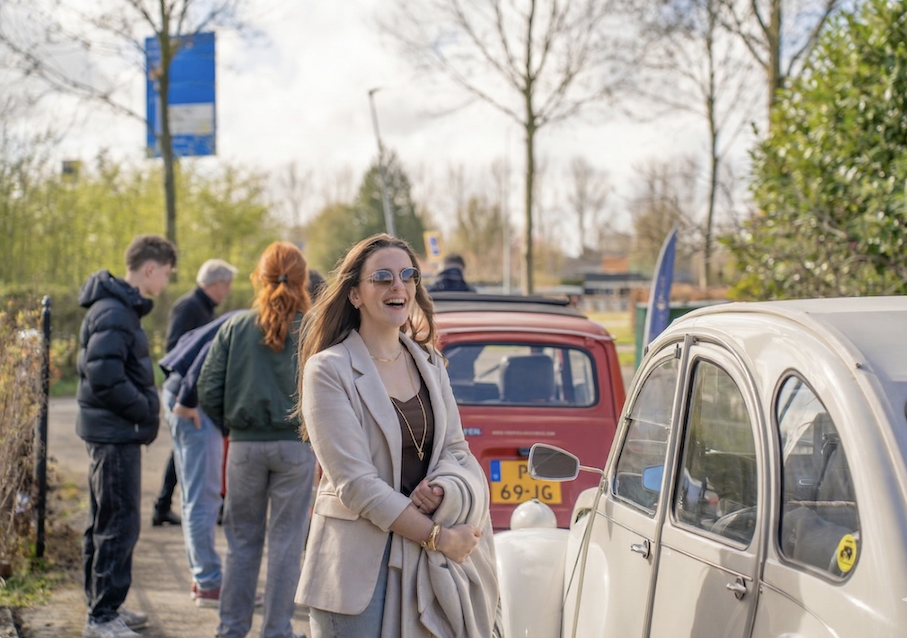
Our 2CV6 Club combines classic charm with just enough power and reliability to keep up comfortably in the modern world. It is not just a car; it is a monument of industrial design and a lasting reminder of an era in which simplicity was the greatest luxury. And how wonderful it is to fully roll back the canvas roof and enjoy the true cabriolet experience. It is perfect for capturing stunning photos at your wedding with this white gem, featuring its beautiful retro checkered upholstery. Or simply for enjoying a relaxed day of touring. Even with four people on board, it remains comfortable and allows you to enjoy the most beautiful, carefully curated (thematic) routes through the idyllic countryside of Groningen.